TRUE CRIME ATLAS

Abraham Lincoln Assassination

Published June 22, 2026Updated June 22, 2026
SolvedVisual case overview

A coordinated plot · twelve days of pursuit · a nation transformed

The conspiracy behind Ford's Theatre

John Wilkes Booth's attack at Ford's Theatre was one part of a coordinated plot against national leaders, followed by a twelve-day pursuit across Maryland and Virginia.

Read the full case overview

On April 14, 1865, President Abraham Lincoln was shot by actor John Wilkes Booth while attending a performance of Our American Cousin at Ford’s Theatre in Washington, D.C. He was carried to the Petersen House across the street and died there at 7:22 a.m. on April 15, while a coordinated plot also targeted Secretary of State William H. Seward and, unsuccessfully, Vice President Andrew Johnson. Booth fled through Maryland into Virginia and was killed on April 26, 1865; several co-conspirators were tried by a military commission, with four executed on July 7, 1865. The assassination was the first of a U.S. president and profoundly shaped the nation’s path during Reconstruction.

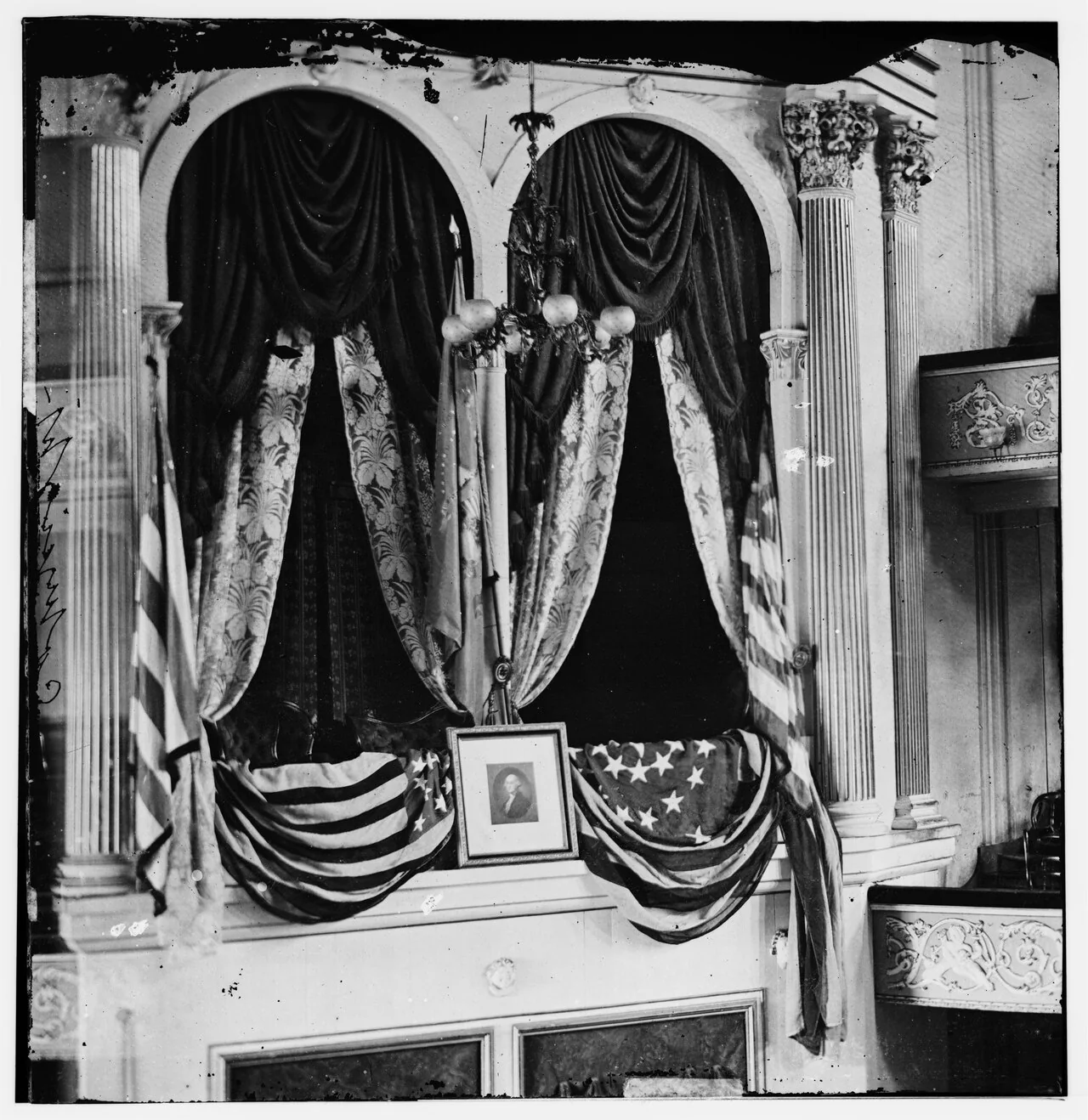
President Lincoln’s Box at Ford’s Theatre (crime scene), 1865

Ford's Theatre

The presidential box where the attack occurred

The scale

The case in four numbers

3
leaders targeted
in the coordinated April 14 plot
12
days of pursuit
before Booth was cornered
8
conspirators tried
by military commission
4
conspirators executed
on July 7, 1865

The plot and pursuit

The assassination was larger than one gunshot

Booth coordinated attacks on national leaders, escaped Washington, and remained at large for twelve days while the government pursued the wider conspiracy.

See all 9 mapped locations →
  1. 01

    Apr 11, 1865

    Booth’s plot hardens from kidnapping to assassination

    In the final days after Appomattox, Booth’s earlier kidnapping conspiracy evolved into a murder plot aimed at destabilizing the Union government through simultaneous attacks.

  2. 02

    Apr 14, 1865

    Booth organizes coordinated attacks after learning of Lincoln’s theater plans

    Booth learned Lincoln would attend Ford’s Theatre that evening and directed his accomplices to target top officials.

  3. 03

    Apr 14, 1865

    Lincoln shot at Ford’s Theatre during Our American Cousin

    Booth entered the State Box at Ford’s Theatre and shot the President; he wounded Major Rathbone while escaping.

  4. 04

    Apr 14, 1865

    Lewis Powell attacks William H. Seward at his home

    As part of Booth’s coordinated conspiracy, Lewis Powell forced his way into Seward’s home and severely wounded the secretary of state, along with several others in the household.

  5. 05

    Apr 14, 1865

    Booth flees Washington via the Navy Yard Bridge

    Booth rode south and crossed the Anacostia River on the Navy Yard (11th Street) Bridge, linking up with David Herold outside the city.

  6. 06

    Apr 26, 1865

    Booth cornered at Garrett’s Farm; Herold surrenders; Booth killed

    Cavalry surrounded the tobacco barn at Garrett’s Farm; after Herold surrendered, the barn was set ablaze and Sergeant Boston Corbett shot Booth.

How the plot connects

Coordination, escape, and prosecution

1
From the case record

Booth shifted an earlier kidnapping scheme into a coordinated assassination plan after the Confederacy's collapse.

2
From the case record

The simultaneous attack on Secretary Seward demonstrates that the plan extended beyond Lincoln.

3
From the case record

The escape route, arrests, military trial, and executions established a prosecuted conspiracy rather than an isolated act.

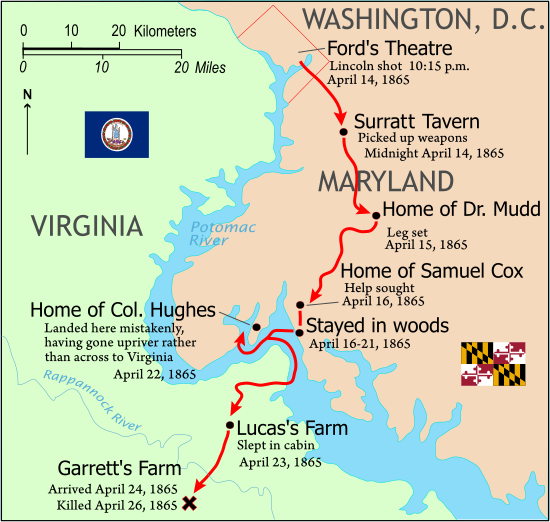
Map of John Wilkes Booth’s escape route, April 14–26, 1865
12
days at large

An escape route became a nationwide manhunt

Booth's flight through Maryland and Virginia links the theater attack to the people, places, and decisions that sustained his escape.

Trace the visual record

Where certainty changes

Not every event carries the same weight

Open each layer to see what the archive treats as core, contested, or unresolved.

01EstablishedBooth led a coordinated assassination conspiracy
The theater attack, Seward assault, escape, accomplice network, and prosecutions establish a multi-person plot.
02ContestedResponsibility among associates was not equal
Participation ranged from direct attack to logistical support, and the military commission's procedures and individual culpability remain debated.
03Open questionWhere did Booth's plan end and wider sympathy begin?
The prosecuted conspiracy is clear, but the boundary between operational support, political sympathy, and unproved wider involvement remains historically contested.

Go deeper

Choose your path through the case

This overview is the map. The case tabs hold the underlying events, people, media, locations, and source material.